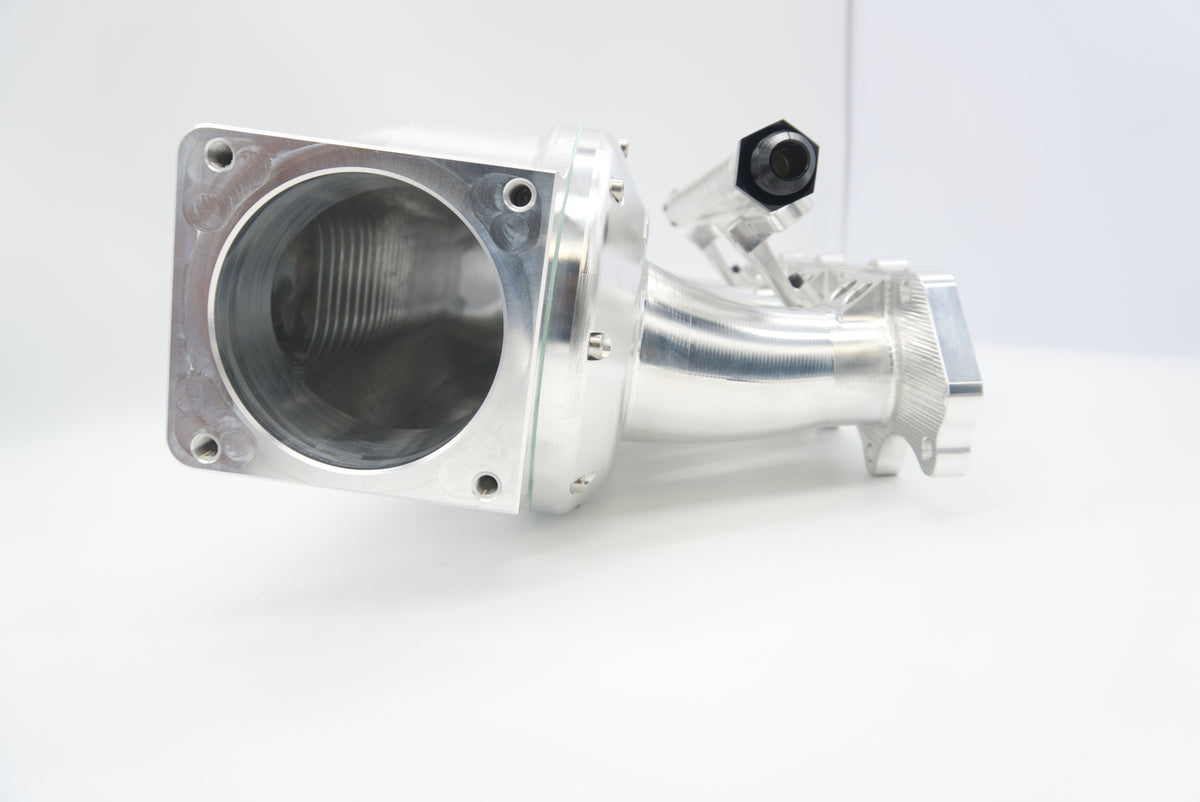
H22 H Series Billet Intake Manifold | ASE
H22 H Series Billet Intake Manifold | ASE
Couldn't load pickup availability
This is the Autosports Engineering Billet Intake Manifold for H Series Engines — a one-piece billet unit developed over roughly three years from the proven ASE DIY manifold kit, with runner geometry validated on a SuperFlow bench before anything was committed to aluminum.
Fitment — read before ordering
Designed around H22 VTEC swap installations in Civic and Integra chassis. Accord and Prelude applications are possible but require modification to the rear transmission bracket — the manifold will not clear without it. If you are running the engine in its original chassis, plan for that work before you order.
Specifications
- Billet 6061-T6 aluminum, machined in-house in the USA
- 8 × 14mm injectors, dual injector configuration
- 90mm Ford-style throttle body flange — fits AEB, K-Tuned, Skunk2 and other standard 90mm patterns
- Big bore fuel rail included
- Thermal plenum gaskets
- NPT ports for booster and vacuum
- Side and center feed options
- Sixteen-bolt plenum retention
What the design does differently
- Curved runners. Straight runners on a front-wheel-drive car tend to put the plenum into the underside of the hood, particularly with spacers. Curving them solves hood clearance, eases charge piping routing, and clears the transmission bracket.
- Round plenum port entry with a long transition. The oval-to-round transition is stretched over a longer distance than the DIY kit, which helps air speed and velocity and keeps the charge off the runner walls — reducing intake air temperature.
- Deliberate internal surface finish. Rough enough to aid air speed and hold IAT down, smooth enough not to restrict. Polishing the runners smooth is a common assumption and the wrong answer.
- Sixteen bolts and a wider, thicker gasket surface with the bolt holes brought inboard, so bolts backing out between rounds doesn't turn into a boost leak.
- Bolted rather than welded. If an engine lets go, the plenum comes off and the manifold can be cleaned out. Welded assemblies trap debris.
- Factory-referenced injector angle. Kept close to Honda's original rather than reoriented for machining convenience, preserving atomization at low air speed so idle and cruise fuel trims stay manageable.
- Bowed plenum back plate for additional plenum volume.
Roughly seven to eight hours of machine time per manifold.
The development story
Read the full three-part development story → — including the flow bench testing at EIC Motorsports that showed 20 CFM swings from inlet radius alone.